
AI Search Only Feels New is a result of shallowhttps://www.linkedin.com/pulse/seo-hasnt-died-has-become-bigger-game-digital-next-uxe3e/
AI search is notorious for changing the game for marketers’ SEO strategies. Traffic has been down, click-throughs have been declining and there are plenty of teams that are saying it’s a whole new ballgame. The truth is, however, that many websites saw the SEO rankings of their content not decline as a result of AI search. It was just a disclosure of what is already a weakness.
Thin, generic content or content that’s written for a keyword, and not a question, were already difficult to navigate with AI Overviews and AI-powered search results. When your content is really deep, it doesn’t seem so dramatic.
A glimpse of today’s state of AI search.
This is backed up by data and should be known prior to making a decision on a strategy. Several independent studies have shown the effect AI Overviews have on organic click-through rates (CTR), and the results vary from 15% to as much as 60% for various types of queries and research methods. The content types that have been the most impacted are questions (which are information, how-to and explainer content).
884
‘
4’’]\
Simultaneously, there is a less talked about process that is going on—recovery. The same research that revealed the substantial declines early on has been tracking an upswing in organic clicks months since the decline while AI Overviews are still visible on the page. That bounce did not take place equally. It was also for websites that offered something for AI search engines –– and human readers –– to cite. This is the part that matters most for your strategy: being cited inside an AI Overview at a lower position can now drive more value than ranking first with no citation at all. Visibility inside the answer is starting to matter as much as the blue link underneath it.
Why “Shallow SEO” Was Always Going to Struggle
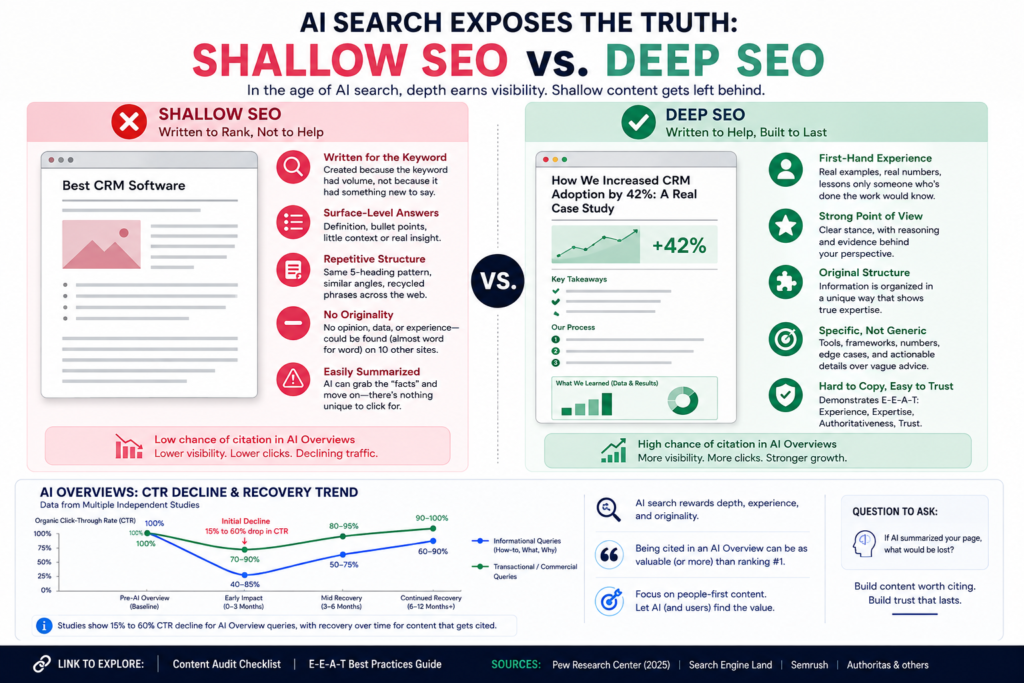
It makes sense that shallow SEO always would be an issue.
The term shallow SEO is not a technical term, it’s a pattern. It’s content that’s created primarily to rank, rather than the individual seeking. It can assume some common shapes:
The first thing I did was write for the keyword – this article was written because the tool said that the keyword had volume and not because it had anything new to say.
Answers that are superficial (definition, bullet list, conclusion, little evidence of first-hand experience, little evidence of some thinking).
Repetition: Structure (hundreds of pages, 5 heading pattern; repetition of nouns).
No opinion or data at all – nothing not specifically relevant to this piece and that can be found (almost word for word) at 10 other sites.
It would be fair to say that the “summarizer” role of an AI system during a search result summarization is exactly what a human skimmmed from shallow content would have done: It could have grabbed the “facts” that are easily discernible and then moved on to the rest. In some ways the click is as good as a summary, if it’s not interesting to begin with, there’s nothing interesting to lose when it’s replaced by a summary.
However, what exactly is “Deep SEO”?What, then is ‘Deep SEO’?
When something is deep, there are typically some aspects that are difficult to build or copy from a competitor, or an AI system:
First-hand experience. One particular case, one real number, one lesson that couldn’t have been learned otherwise, any lesson that only someone who has performed the task could learn.
A definite point of view. A clear preference and explanation of why it is preferred and reasoning to back this up.
Original structure. Presenting the information in a manner which demonstrates a true level of expertise, rather than a copy of the top competitor.
Specificity over generality. Avoid ‘vaguish’ words which may be relevant to any tool, number, edge case etc.
It’s no wonder that this is the same formula that Google has been advocating for years, E-E-A-T (experience, expertise, authoritativeness and trustworthiness). There is no breakthrough in the use of AI search. It’s a bit more rigid on applying it, and, it’s definitely capable of identifying content that fails to adhere to it.
A Practical Framework for Auditing Your Content
An audit outline of your content, step by step.
The following is a useful Triage to see whether you are lost or not if you are attempting to determine where your site is:
Step
What to Check
What It Tells You
1. Segment traffic
If you have a group of pages to include information, look at the decrease in organic page sessions before and after your query set is served an AI Overviews.
Identifies topics that you are susceptible to being exposed to
2. Check citation status
Use your target keywords to search and find out if your page is referenced in the AI Overview.
Demonstrates if you are a part of the answer
3. Read it cold
Read the page as if you haven’t read it — are there any words, phrases, or sentences on the page that are not included in your summary?
Shallow content is explicitly marked with flags.
4. Compare to competitors
Look at those who are ranking and/or cited above you – what pieces of them do you not include?
Identifies certain gaps in depth
6. Present tense tense
Before re-publishing add a real-life example or a stated opinion or original data
Makes trivial into a quotation that has meaning
Stay away from the dangers of AI search response.Try to prevent some of the most frequent pitfalls teams fall into when answering AI search.
Fearing the loss of ground and creating more content in a rush. Volume is never the answer to bad content, and AI search will be more stringent on shallow content than on deep content.
Not just attempting to get workarounds around AI detection.Not just trying to find workarounds for detecting AI. It’s a mistake to try and push shallow content through a system pretending that it is deep content.
Ignoring pages that are still performing. When learning why some pages are steady, the skip of the audit step is an opportunity lost to learn how to duplicate those pages.
Considering solely a technical view. Structured data and schema markup aid in visibility and can help create depth but depth does not have to be created.
Limitations Worth Knowing
Some industries and kinds of queries are affected to a lesser extent. While local and near-me queries are exceptions, informational searches have been less well represented by AI Overview than have transaction and commercial searches. Results also depend on the methodology of the studies conducted and on the way in which the “AI Overview presence” is assessed; therefore, use any one statistic as a guide, not as a concrete number
FAQs
With the rise of AI search, is there a need for traditional SEO? No. AI search has shifted the paradigm of who is seen as visible and who is not, but the value of the content, its organisation and originality remain the key to citations and clicks.
How to identify “shallow” content? Read it as you would if you were reading it for the first time. It’s shallow if it can be substituted elsewhere in the article with no loss of any detail that is unique to your skills or experiences.
But will the traffic be recovered by improving the depth of the content? But it will not assure a complete recovery: some clicks are lost, for example, to zero click answers. However, content with deeper meaning has done better and bounced back more than generic content over the data that’s available.
Key Takeaways
With AI search, quality content is being rewarded and content that is optimized for ranking is being punished.
In fact, being cited within an AI Overview is as important as, if not more important than, ranking position.
It’s not “gaming the system” by building detection systems, it’s checking the originality of your content and improving the shallow pieces by adding a genuine level of expertise and stating a point of view.
Suggested image placement: (1) Featured image – split graphic that shows the difference between “shallow content” and “content with depth” characteristics. (3) End of Article — simple table or chart showing the trend of CTR decline/recovery for AI Overview queries. Alt text ideas: Graphic comparison shallow SEO vs AI search. AI Overview citation vs ranking position.
Internal linking opportunity: Use a link to a related post on E-E-A-T best practices or content audit checklist.
Consider linking to Pew Research Center’s study on AI Overviews and search behavior or Google’s Search Central documentation on E-E-A-T as authoritative links.